


Upcoming
2nd session of the Intergovernmental Working Group on the Human Rights of Older Persons
IDA at the 2nd session of the Intergovernmental Working Group on the Human Rights of Older Persons
From 26 to 30 October, the Intergovernmental Working Group on the Human Rights of Older Persons will hold its second session in Geneva. The International Disability Alliance will be present at every panel, bringing the main concerns of older persons with disabilities from a disability rights perspective.
About the event
The Intergovernmental Working Group on the Human Rights of Older Persons will hold its second session from 26 to 30 October at the Palais des Nations in Geneva, Switzerland.
This session continues the process that began at the first session in July 2026. Those discussions broadly covered the overarching framework, core principles, and overall structure of a future convention on the rights of older persons.
At the second session, the Working Group will move the discussions forward towards the potential content of a future legally binding instrument on the rights of older persons. The session will bring together:
•State representatives
•UN agencies
•Civil society organisations, particularly from the older persons' rights community
•Academia and other stakeholders
They will share views and insights on what should be included in a future treaty.
After the second session, a call for written submissions is expected. The Working Group would then start work on the draft text of the future convention, which will be discussed in future sessions.
All meetings of the second session are public and will be webcast on UN Web TV.
All the relevant information, including the session's Programme of Work, is available here.
The CRPD as the minimum floor for standard setting on the rights of older persons, inclusive of older persons with disabilities
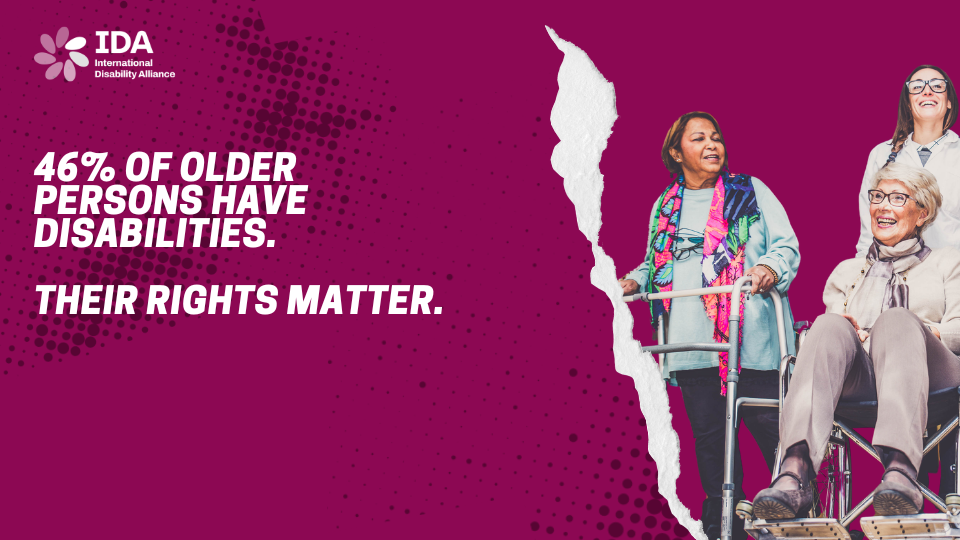
Global estimates suggest that around 46% of older persons have impairments, and this figure is likely to increase. An ageing population will therefore mean more disability. That brings greater demand and needs (whether met or not) for support services, assistive devices, health care services and accessibility across the board, to name just a few.
Older persons with disabilities face negative perceptions, stigma and stereotypes that are both ableist and ageist. As a result, they experience discrimination based on age and/or disability, including multiple and intersectional discrimination. They are also likely to be poor, excluded, isolated, institutionalised, victims of violence and abuse, and without access to support measures.
A process on the rights of older persons must take a strong intersectional approach and consider the situation of older persons with disabilities. It must not in any way water down the human rights standards in the CRPD. Instead, the process is an opportunity to strengthen those standards by addressing the specific situation of older persons with disabilities.
IDA at the 2nd session of the Intergovernmental Working Group
IDA has engaged, and will keep engaging, so that issues affecting older persons with disabilities become visible to States and other stakeholders and are properly addressed.
In April, ahead of the first session, IDA submitted a brief written contribution. For the session itself, IDA's President, Mr Nawaf Kabbara, went to Geneva to represent the Alliance, showing the great interest and importance IDA gives to this law-making process. He also met State representatives and colleagues from the older persons' rights community. IDA's statements from different panels of the first session are available here.
There has been no call for written contributions for the second session, but IDA will be at every single panel, bringing the main concerns of older persons with disabilities from a disability rights perspective!