


Editorial - The missing investment in development finance: Why organisations of persons with disabilities must be financed as agents of change across every development agenda
The missing investment in development finance: Why organisations of persons with disabilities must be financed as agents of change across every development agenda
By José María Viera, Executive Director, International Disability Alliance
As global financial leaders gather in Bangkok for the Annual Meetings of the World Bank and International Monetary Fund, one question will dominate many conversations: how can we mobilise more finance, at greater scale, to tackle the world's most pressing challenges?
It is the right question, but it is not the only one we should be asking.
At the recent Building Bridges conference in Geneva, investors, development institutions and policymakers discussed how to make sustainable development more investable. The conversations focused on mobilising institutional capital,building markets, managing risk and designing financial instruments capable ofaddressing challenges from climate change to infrastructure and economicgrowth.
These are important ambitions. Yet there is a missing dimension in much of the debate about the future of development finance: who has the power, resources and opportunity to shape the development that is being financed?
We have become increasingly sophisticated at designing financial instruments to move capital. We have been less successful at financing the organisations capable of ensuring that this capital delivers equitable, sustainable and lasting change.
For the world's 1.3 billion persons with disabilities, this is not an abstract concern. It is a fundamental question about whose knowledge matters, whose priorities determine investment decisions, and who gets to participate in shaping the societies we are building.
For too long, development actors have approached disability inclusion primarily as a question of ensuring that persons with disabilities benefit from programmes designed by others.
We ask whether a school is accessible, whether a transport project includes wheelchair users, whether a social protection programme reaches persons with disabilities, or whether an employment initiative includes workers with disabilities. These are important questions. But they reflect only part of what inclusion should mean.
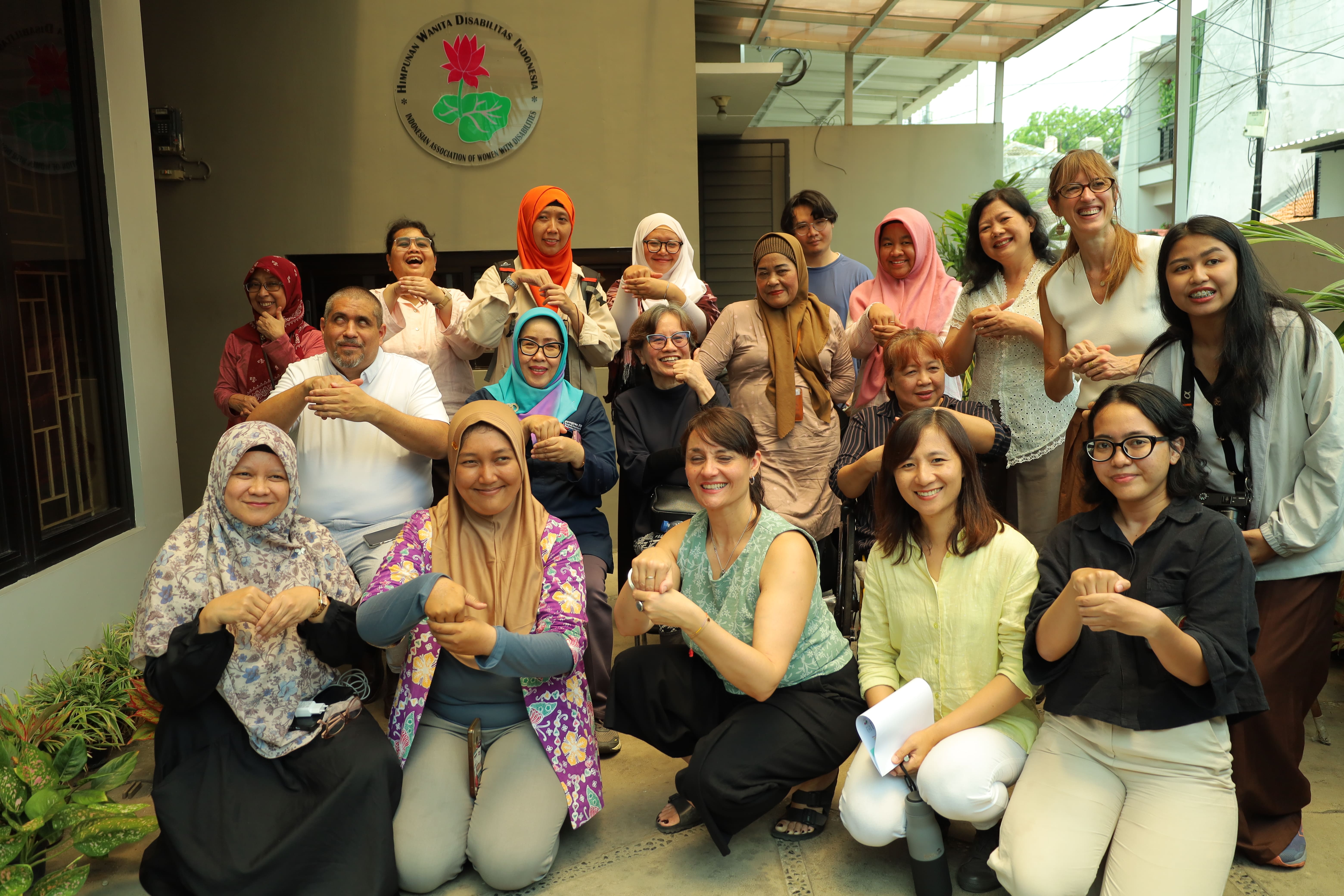
A couple of weeks ago I visited Indonesia, and an OPD leader, Laura, told me she was so excited that a new hospital was going to be built in her community with money from a development bank. But Laura is deaf and found out that the accessibility requirement was limited to ramps for wheelchairs, and information and communication accessibility and reasonable accommodation were not otherwise provided or guaranteed. She will have to pay for the sign-interpretation herself. For Laura there are two problems: first, she will never access health care on an equal basis with others. and the second and perhaps even bigger problems – decision makers and financial institutions often believe the work on inclusion is completed once a ramp has been built. Like this, there are many examples of how projects aren't as useful, effective or inclusive when not co-designed by OPDs. How often are investments not only not sufficiently inclusive and OPD-led but also potentially harmful to persons with disabilities? We need to be clear that if we want to change, it has to be done properly; otherwise, let's not even bother.
Persons with disabilities are not simply beneficiaries of development. We are political, social and economic actors with the knowledge, expertise and legitimacy to shape development itself. Our representative organisations – organisations of persons with disabilities – have helped transform laws, challenge discrimination, establish new standards, reform public institutions and change expectations about what inclusive societies should look like.
The Convention on the Rights of Persons with Disabilities is itself a powerful demonstration of what happens when persons with disabilities are recognised as leaders rather than passive recipients of assistance. It fundamentally changed the international understanding of disability, establishing persons with disabilities as rights-holders and active participants in decisions affecting their lives.
Yet nearly two decades after the Convention's adoption, we continue to finance development in ways that don’t reflect that paradigm shift and often leave OPDs struggling to sustain their basic operations, let alone exercise meaningful influence.
The result is a striking contradiction: we expect OPDs to help transform national systems but frequently resource them as though they were temporary participants in projects designed elsewhere.
We need to change this relationship and have a paradigm shift in international cooperation for persons with disabilities, building by us for us.
The question should no longer be only how much development funding is allocated to disability inclusion. It is about how and who we invest in. This means thinking more deeply about how to invest in the organisations that can drive inclusive development across every agenda.
Every development agenda can and should also be financed as a disability agenda, and this is the perspective that the International Disability Alliance is bringing to the discussions in Bangkok.
When governments and financial institutions invest in climate adaptation, persons with disabilities have valuable knowledge about accessible early warning systems, resilient housing, evacuation arrangements and community preparedness.
When countries develop digital economies and introduce artificial intelligence, OPDs can help ensure that new technologies expand opportunities rather than create new forms of exclusion. Their expertise matters when governments establish digital identification systems, automate social protection decisions or procure technologies for public services.
When public authorities plan transport networks, OPDs can help shape systems that work for everyone from the outset, rather than requiring expensive modifications after infrastructure has been built.
When governments reform taxation, social protection or public spending, persons with disabilities can contribute evidence about poverty, disability-related costs, barriers to employment and the consequences of fiscal decisions for households and communities.
When countries develop agricultural policies, industrial strategies, health systems, education reforms or humanitarian responses, OPDs bring perspectives essential to the effectiveness and legitimacy of those policies.
And when governments and investors seek to create jobs and expand economic opportunity, persons with disabilities should help define what a genuinely inclusive labour market looks like.
%20(1).jpg)
These are not peripheral disability concerns. They are questions about how economies function, how institutions operate and whether development benefits society as a whole.
OPD should not have to wait for a project to acquire a disability component before they become relevant to it. Their expertise should help shape the project itself.
This requires moving beyond consultations organised after priorities have already been determined. It means recognising OPDs as partners in diagnosing problems, developing policy, designing investments, implementing reforms and evaluating outcomes.
It also requires recognising that OPDs are not merely advocates asking others to act. They can be providers of specialised technical expertise, partners ininnovation, contributors to market development, and independent monitors ofpublic and private investment.
We know that we cannot build long-term change on short-term funding, but somehow this is expected from OPDs. OPDs across the world operate in a deeply insecure financing environment, with most depending on small, short-term grants tied to narrowly defined activities. Funding may cover a workshop or consultation, but not the staff, research, governance, accessibility or organisational infrastructure required to sustain advocacy, knowledge generation, solutions and innovation delivery.
We should consider the implications and dynamics within the development agenda. The government may receive hundreds of millions of dollars to reform a sector, while the representative organisations expected to contribute to that reform have no assured resources to examine the proposals, consult their members or monitor implementation.
A development bank can commission international consultants to assess a major investment, while OPDs with direct knowledge of the barriers that investment should address are invited to contribute their expertise without adequate compensation.
We would not expect a financial institution, research centre or technical advisory organisation to operate effectively without predictable funding. Yet we repeatedly make that assumption about organisations representing persons with disabilities.
For OPD to contribute to systemic change, we must finance them as institutions capable of sustaining that change.
That means long-term, flexible and predictable support, including funding for institutional development, governance, leadership, research, accessibility, communications and organisational resilience.
It also means recognising the diversity of the movement and ensuring that fundingreaches organisations representing people who have been most excluded,including women and girls with disabilities, persons with intellectual orpsychosocial disabilities, deafblind persons, Indigenous persons withdisabilities and other under-represented groups.
Financing OPDs is also an investment in development effectiveness. The international community increasingly recognises that development finance must do more than simply fund individual projects. It must strengthen systems, build institutions, mobilise knowledge and create conditions for lasting change.
The same logic should apply to OPDs. Investing in a representative organisation can generate influence across multiple sectors and over many years. An OPD supported to develop its technical capacity and institutional strength may contribute to reforms in education, employment, healthcare, social protection and public infrastructure. Its ability to influence decisions does not end when an individual project closes. This is particularly relevant to the current debate about market creation.
Much of the conversation about mobilising private capital focuses on making projects financially viable and on reducing risks for investors. But markets are also shaped by public rules, institutional capacity, procurement decisions, product standards and an understanding of people's needs.
Consider assistive technology. Expanding affordable access requires more than investment in manufacturers or distributors. It requires understanding unmet demand, addressing barriers to procurement, developing appropriate policies, supporting accessible services and ensuring that products respond to users' priorities. OPDs can contribute throughout this process.
Likewise, an accessible digital economy does not emerge simply because capital becomes available to technology companies. Accessibility must be embedded in regulation, design, procurement, testing and accountability. OPDs have an essential role in establishing those expectations.
The private sector may provide investment capital. Governments may establish policy frameworks. Development banks may provide financing and expertise. But OPD helps ensure that the systems being created respond to the rights and realities of the people they are intended to serve.
This is why financing OPDs should be understood as an investment in the enabling conditions for successful development, not simply as another category of charitable expenditure.
At the same time, we must not confuse financial returns with development value. Independent advocacy, democratic participation and human rights accountability are public goods. They should not be required to generate commercial returns to justify their financing. Grants and public investment will remain indispensable, even as private capital plays a greater role in development.
.jpg)
From commitments to a new financing relationship
We already have a strong foundation for changing how OPDs are financed from the human rights framework – the CRPD Committee explicitly recommending direct funding for OPDs, sustainable core institutional support, accessible funding processes and protection of organisational autonomy. But this remains the exception, not the rule.
At the 2025 Global Disability Summit in Berlin, co-hosted by Germany, Jordan and the International Disability Alliance, governments and development partners adopted Amman-Berlin Declaration, including the ambition that at least 15% of international development programmes implemented at the country level pursue disability inclusion as an objective by 2028.
This represents an important step forward. But the target will achieve its transformative potential only if OPDs are sufficiently resourced to influence how these programmes are conceived, delivered and assessed. It is time to translate these principles and commitments into a financing architecture that recognises OPD leadership.
We need donors, governments and philanthropic institutions to expand direct, multi-year core financing for OPDs, with proportionate accountability requirements and accessible funding procedures. Where intermediary arrangements are necessary, they should strengthen local leadership and support an eventual transition toward direct financing, rather than entrenching dependence.
We need development banks to systematically resource OPD participation in country strategies, sector reforms and investment operations. OPDs should be engaged at the stage when priorities and investments are being defined, not merely asked to comment once decisions are largely settled.
We need financing for OPD-led technical assistance. When representative organisations provide expertise on accessibility, inclusive social protection, climateresilience, public services or digital systems, they should be recognised and appropriately compensated as technical partners.
Equally, we need separate support for independent monitoring and advocacy. Financing must strengthen OPDs' capacity to challenge decisions, including those of the institutions that provide their funding. Partnership cannot mean surrendering independence.
And we need transparency. Development partners should be able to demonstrate how much funding reaches OPDs, how much is flexible and long-term, how much supports their independent advocacy, and whether OPDs have meaningfully influenced development outcomes.
For the World Bank, this should connect to its country engagement, operational financing and results frameworks. For the IMF, whose mandate and financing instruments are different, the challenge is to ensure that fiscal policy dialogue, surveillance and reform programmes sufficiently consider the rights and circumstances of persons with disabilities, with appropriately supported engagement from their representative organisations.
The wider international financing system – including bilateral donors, global funds, philanthropies and national governments – must provide the grant financing that makes such engagement possible.
A challenge for Bangkok
The development community is right to pursue finance at scale. The challenges we face are too large for fragmented interventions or short-term thinking. But scale cannot be measured in dollars alone. It must also be measured by the depth of institutional change, the durability of reforms and the extent to which people can exercise influence over the decisions shaping their lives.
As the World Bank and IMF meet in Bangkok, we should ask a different set of questions alongside the familiar ones about capital mobilisation:
How much are we investing in the representative organisations that can make development more inclusive? Are we financing their independent leadership or merely their attendance at consultations? Are we enabling OPDs to shape economic and social policy across every sector or confining them to a narrow disability agenda?
And are we prepared to recognise these organisations as development actors in their own right, with expertise and authority that merit sustained investment?
At the International Disability Alliance, our global movement demonstrates every day that persons with disabilities are not waiting for change to happen to us.Through our representative organisations, we are helping to shape laws, policies, institutions and communities.
What remains missing is a financing system that fully recognises this contribution.
The debate about sustainable finance increasingly calls for longer investment horizons, stronger partnerships and greater attention to systemic change. We understand that this must mean a genuinely long-term approach which also invests in the people and organisations that make change possible.
The next frontier of development finance is not only finding new ways to fund development. It is redistributing the resources and opportunities to shape development itself.
Financing OPDs is an investment in leadership, democratic participation, stronger institutions and better development outcomes. It is an investment whose value extends across every sector and every agenda.
If we want to build more inclusive, resilient and prosperous societies, we must stop treating representative organisations of persons with disabilities as an afterthought in development finance.
We must finance them as agents of change – and as essential partners in determining the future we all share.
.jpg)
